
Insights from the Quirk’s Event London 2026: AI enters the execution era
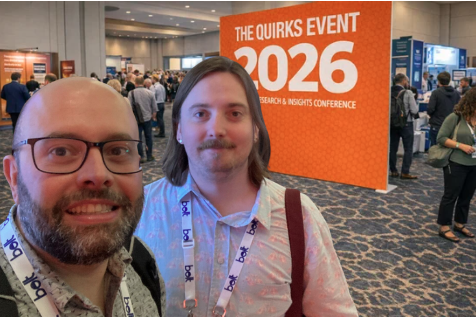
AI is still the name of the game, but the conversation has changed. Head of Innovation, Paolo Gambetti and Data Analytics Manager, Michael Butler, recently attended the Quirk’s Event in London. Their key takeaway? AI is still the name of the game, but the conversation has changed. There was far less focus on AI as a new or exciting tool, and far more attention on a tougher question: is it actually helping, and how can it be used effectively, safely, and ethically?
From novelty to necessity
One of the most striking shifts was how widely AI is now taken for granted. It is already embedded in workflows across the industry, and the debate has clearly moved on from adoption to impact. Having access to AI is no longer a differentiator. Instead, the focus is on whether it is properly integrated into ways of working, and whether it can be trusted to deliver meaningful, reliable outputs.
From using AI tools to becoming AI-assisted
A recurring theme throughout the conference was the need for a mindset shift. Much like laptops, which are now simply part of how work gets done, AI is expected to follow the same trajectory. The challenge is no longer to experiment with AI tools on an ad hoc basis, but to embed them into the core of how organisations operate. The real transition is from a research company that uses AI, to one that is fully AI-assisted.
Assistant, not replacement
Encouragingly, AI is widely seen as an assistant rather than a replacement. Evidence shared during the conference suggested that teams are being reshaped and adapted, rather than reduced or removed. Roles are evolving, responsibilities are shifting, but the human element of research remains firmly in place.
The human role is becoming clearer
As AI capabilities continue to develop, the value of what humans bring is becoming more defined. AI literacy is now an essential skill, but it is not what sets teams apart. Creativity, originality, and the ability to build trust and relationships are increasingly important.
Storytelling stood out as a key driver. As AI-generated outputs become more standardised, the ability to interpret findings, connect the dots, and communicate insights in a compelling way is what differentiates strong research teams from the rest.
Quality under pressure
The rise of AI is closely linked to the rise of fraud, creating an ongoing challenge for data quality. As fraudulent behaviours become more sophisticated, the industry response is evolving quickly. New tools are being developed to detect and prevent these risks, with AI increasingly being used to fight AI. Ensuring the integrity of data is becoming just as important as generating insights at speed.
First-time perspective from the expo floor
For Michael Butler, attending Quirk’s was his first experience at a market research and insights conference, giving him a fresh and personal perspective: “As a first-time conference attendee, I initially felt anxious walking into the expo hall. However, that quickly changed as I began speaking with exhibitors, researchers, and technology providers. The openness and kindness across the industry made it easy to feel part of a wider community, united by a shared desire to learn and grow. Seeing how AI is being applied across different areas was particularly valuable, and I left feeling inspired and more confident in applying these learnings back into my own work.”
Closing reflections
The Quirk’s Event highlighted a clear shift in how the industry is approaching AI. The focus is no longer on capability, but on how AI is embedded, governed, and used responsibly within real workflows.
The real challenge now is execution: integrating AI into processes, maintaining data quality, and ensuring that human expertise remains at the centre of insight generation.